From Theory to Theatre:
Directed Energy Weapons in ServiceFor decades, directed energy weapons sat firmly in the realm of theory. Lasers and microwaves were familiar tropes in science fiction and defence concept papers, but rarely seen as practical tools for the battlefield. That perception is now outdated.
Across the UK, United States, and allied nations, directed energy weapons are transitioning from experimental programmes into deployed capabilities, reshaping how modern militaries think about air defence, counter-drone operations, and the economics of warfare.
This shift is not being driven by novelty. It is being forced by scale, speed, and cost, particularly in response to the proliferation of uncrewed aerial systems and the emergence of mass drone attacks. Directed energy is no longer about futuristic promise, it is about operational necessity.
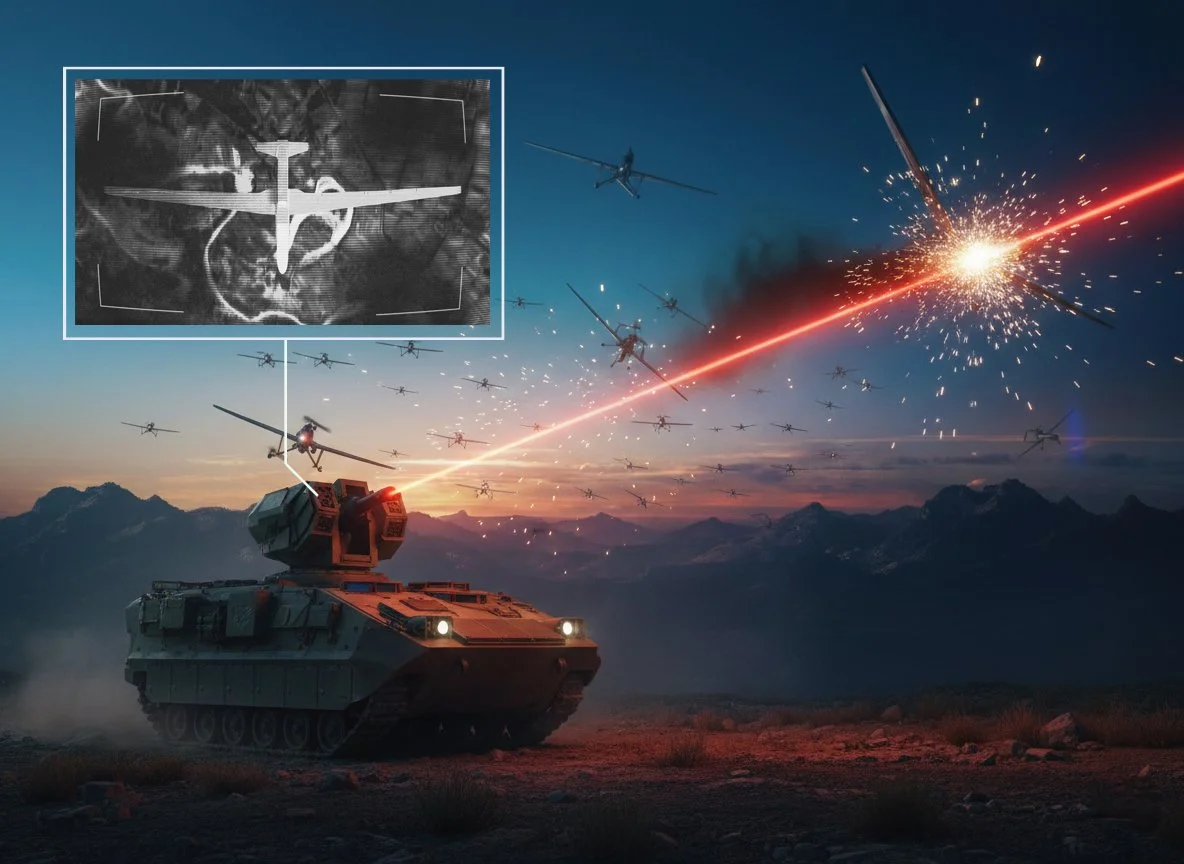
Why Directed Energy Matters NowThe contemporary battlespace has changed faster than traditional air defence models can adapt. Cheap, networked, and often autonomous drones have become ubiquitous, whether deployed by state militaries or non-state actors. Using high-cost interceptor missiles to defeat low-cost drones is economically unsustainable, a reality increasingly acknowledged by defence planners and auditors alike (4).
Directed energy weapons, which deliver energy directly to a target in the form of lasers or high-power microwaves, offer a fundamentally different cost equation. Once fielded, they trade expensive munitions for electrical power, dramatically lowering the cost per engagement. This economic logic sits at the heart of their renewed relevance (9).
Lasers Move from Trial to FleetThe United Kingdom’s DragonFire laser programme offers one of the clearest signals that directed energy has entered the operational domain. Developed through close collaboration between the Ministry of Defence, industry partners, and Defence Equipment and Support (DE&S), DragonFire has demonstrated the ability to accurately engage aerial targets at range, with the Royal Navy preparing for integration onto future platforms (1).
What matters here is not just the laser itself, but the model behind it. DragonFire reflects a shift toward modular, upgradable systems that can be iterated rapidly as power generation, beam control, and targeting software improve. Rather than a single monolithic weapon, the laser becomes part of a broader combat system, tightly integrated with sensors, command systems, and shipboard power management (1).
The US Acceleration: Countering Mass Drone ThreatsAcross the Atlantic, urgency is even more pronounced. The US Army is accelerating both laser and microwave weapon programmes to counter mass drone attacks, recognising that future conflicts may involve dozens or hundreds of simultaneous aerial threats (2).
High-energy lasers excel at precision engagement, burning through airframes or disabling sensors. High-power microwaves, by contrast, can disrupt or destroy electronics across a wider area, making them particularly effective against swarms. The US Navy’s Office of Naval Research continues to invest heavily in microwave systems designed to defeat groups of drones or fast attack craft without the need for individual targeting (3).
This dual-track approach highlights a critical truth, there is no single directed energy solution. Instead, militaries are building layered defences that combine lasers, microwaves, kinetic interceptors, and electronic warfare into integrated architectures.
The Real Bottleneck: Power, Not PhysicsDespite the popular focus on beam power and range, most official assessments point to more prosaic challenges. Government Accountability Office reporting consistently identifies power generation, thermal management, and system integration as the primary barriers to widespread deployment, not the underlying physics of lasers or microwaves (4).
Generating sufficient power on mobile platforms, managing waste heat, and maintaining beam quality under real-world conditions are complex engineering problems. These challenges extend well beyond weapons labs, pulling in expertise from energy systems, advanced materials, AI-enabled targeting, and resilient software architectures.
This is where directed energy intersects with the broader defence technology ecosystem. Many of the enabling innovations come from dual-use sectors rather than traditional arms manufacturing, a trend emphasised by both policy analysts and defence research bodies (5).

An Old Technology, RecontextualisedDirected energy is often described as new, but it is better understood as newly viable. Concepts for laser weapons date back to the Cold War, but only recent advances in solid-state lasers, power electronics, sensors, and computing have made them practical at scale (5).
Modern directed energy systems benefit from decades of progress in commercial photonics, semiconductor manufacturing, and automation. This convergence has reduced size, weight, and power requirements while increasing reliability, enabling deployment on ships, vehicles, and potentially aircraft.
Policy briefings from the US Congressional Research Service underline that this maturation is incremental rather than revolutionary. Directed energy is evolving alongside conventional systems, not replacing them wholesale (6).
Governance, Control, and ProliferationAs directed energy weapons become operational, questions of governance and control grow more pressing. International bodies and national science agencies have highlighted concerns around proliferation, research security, and the blurring of civilian and military applications (7).
Because many enabling technologies are commercially available, regulating directed energy is more complex than controlling traditional munitions. Arms control organisations note that existing legal frameworks struggle to account for weapons defined by energy delivery rather than physical payloads (8).
This ambiguity creates tension. On one hand, directed energy offers defensive benefits, particularly in counter-drone roles. On the other, its accessibility raises long-term questions about escalation and misuse. These issues are increasingly central to defence policy debates, even as deployment accelerates.
Cost, Sustainability, and Strategic LogicOne of the strongest arguments for directed energy lies in sustainability. Traditional air defence systems rely on supply chains that can be strained in prolonged conflict. Missiles must be manufactured, transported, and replaced. Lasers and microwaves, by contrast, depend primarily on electrical power and maintenance.
Industry analysis highlights that this shift could fundamentally alter how militaries plan for endurance and resilience, particularly in contested logistics environments (9). Directed energy does not remove the need for kinetic weapons, but it reduces dependency on them for routine engagements.
RAND analysis reinforces this point, framing directed energy as a response to intensity rather than novelty. As the volume of threats increases, the economics of defence matter as much as performance (10).
From Capability to DoctrinePerhaps the most significant transformation is doctrinal. Directed energy weapons are forcing militaries to rethink how they defend assets, allocate resources, and design platforms. Ships, vehicles, and bases are now being conceived with power margins, cooling capacity, and modular integration in mind.
This is a subtle but profound shift. Weapons are no longer bolt-on additions, they are drivers of platform architecture. As directed energy systems mature, they will increasingly shape how future forces are designed and deployed.
ConclusionDirected energy weapons have crossed a threshold. What began as theoretical research and speculative fiction has entered service, driven by practical needs rather than technological ambition. Lasers and microwaves are not wonder weapons, but they are becoming indispensable tools within layered defence systems.
The real story is not about beams of light, it is about systems, integration, and economics. Directed energy reflects how modern warfare is changing, faster, more distributed, and constrained by cost as much as capability. From theory to theatre, directed energy is no longer a promise. It is a reality.
Also By Us:











References
1. UK Ministry of Defence. (2024). DES working with mission partners to deliver laser directed energy weapon for the Royal Navy. Accessed at https://des.mod.uk/what-we-do/partnering-with-industry-case-studies/des-working-with-mission-partners-to-deliver-laser-directed-energy-weapon-for-the-royal-navy/
2. Army Recognition. (2026). U.S. Army accelerates laser and microwave weapons to defeat mass drone attacks. Accessed at https://www.armyrecognition.com/news/army-news/2026/u-s-army-accelerates-laser-and-microwave-weapons-to-defeat-mass-drone-attacks
3. Office of Naval Research. (n.d.). Directed energy weapons: High-power microwaves. Accessed at https://www.onr.navy.mil/organization/departments/code-35/division-353/directed-energy-weapons-high-power-microwaves
4. U.S. Government Accountability Office. (2023). Directed energy weapons: DOD should improve planning for future capabilities (GAO-23-106717). Accessed at https://www.gao.gov/products/gao-23-106717
5. United Nations Institute for Disarmament Research. (2023). Directed energy weapons: A new look at an old technology. Accessed at https://unidir.org/directed-energy-weapons-a-new-look-at-an-old-technology/
6. Congressional Research Service. (2023). Directed energy weapons: Issues for Congress (R46925). Accessed at https://www.congress.gov/crs-product/R46925
7. Government of Canada. (2023). Emerging technology trend cards: Directed energy weapons. Accessed at https://science.gc.ca/site/science/en/safeguarding-your-research/guidelines-and-tools-implement-research-security/emerging-technology-trend-cards/directed-energy-weapons
8. Arms Control Center. (n.d.). Fact sheet: Directed energy weapons. Accessed at https://armscontrolcenter.org/fact-sheet-directed-energy-weapons/
9. Honeywell Aerospace. (2023). Directed energy weapons come of age. Accessed at https://aerospace.honeywell.com/us/en/about-us/blogs/directed-energy-weapons-come-of-age
10. RAND Corporation. (2024). Directed energy: The focus on laser weapons intensifies. Accessed at https://www.rand.org/pubs/commentary/2024/01/directed-energy-the-focus-on-laser-weapons-intensifies.html