The Saturation Trap:
How Swarming Drones Could Break Traditional Air Defence Systems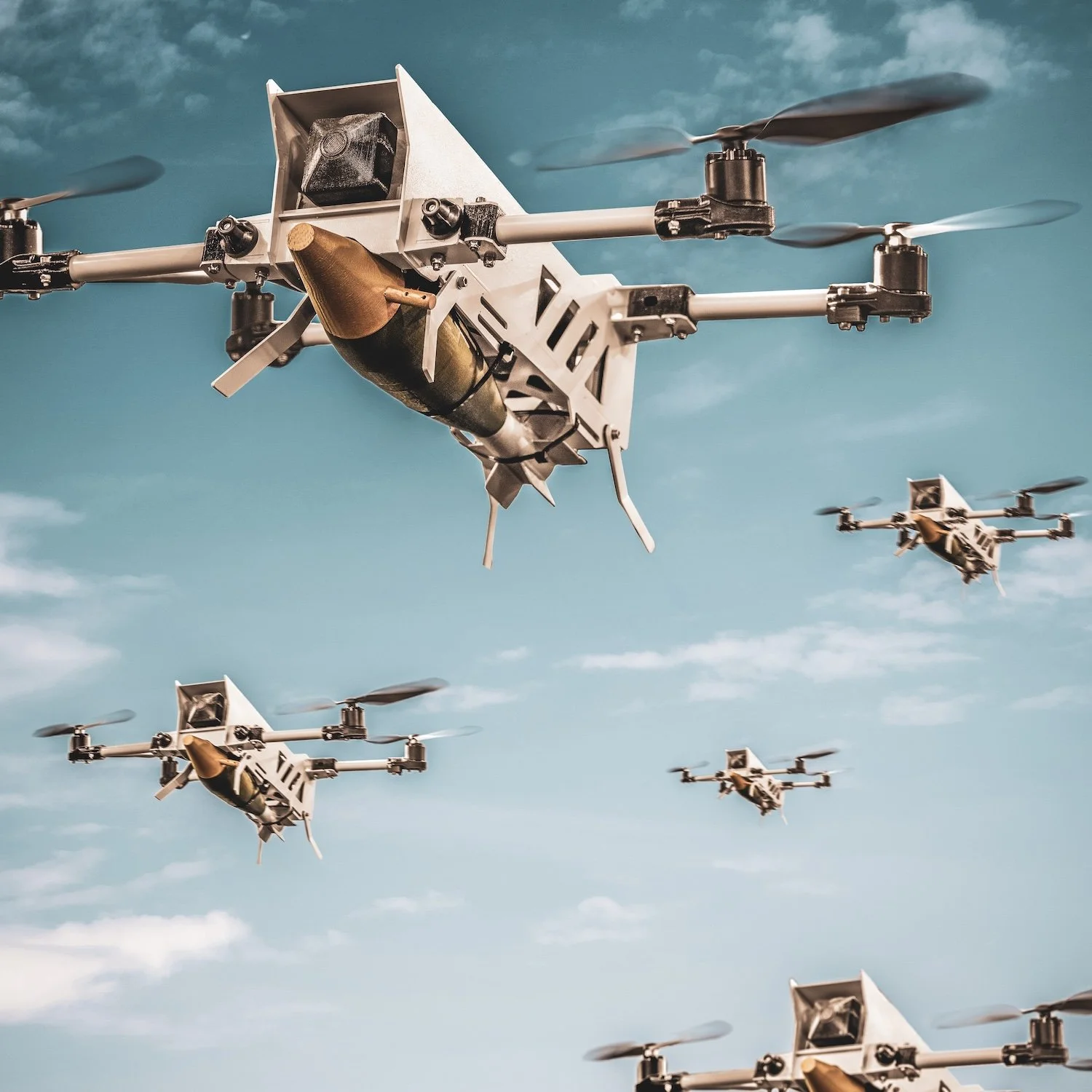
Modern air defence systems are among the most complex and expensive military capabilities ever constructed. Layered radar arrays, precision interceptors, command-and-control networks, and highly trained operators are designed to protect airspace from aircraft, cruise missiles, and ballistic threats. Yet these systems share a fundamental vulnerability. They were designed for an era of scarcity, scarcity of targets, scarcity of attack vectors, and scarcity of simultaneous threats. Swarming drones exploit this assumption, creating a saturation trap from which traditional air defence struggles to escape.
This is not a story about speculative artificial intelligence or exotic future weapons. It is a story about arithmetic, attention, and systems logic. Swarming drones do not need to be individually sophisticated to be strategically disruptive. Their power lies in numbers, coordination, and disposability, and in how those characteristics collide with the design assumptions of legacy air defence architectures.
Air Defence and the Assumption of ScarcityConventional air defence doctrine evolved around high-value, limited threats. A fighter aircraft, bomber, or missile represented a significant investment by the attacker and could be detected, prioritised, and engaged individually (1). Even during massed missile attacks, planners generally assumed that the number of incoming threats would remain within the engagement capacity of defensive systems.
This assumption shaped everything from radar architecture to interceptor economics. Sensors were optimised to track a manageable number of objects. Fire-control systems were built to allocate limited interceptors against the most dangerous targets. Human operators played a central role in evaluating threats and authorising engagements.
Within this paradigm, quality outweighed quantity. A single advanced interceptor neutralising a single high-value target represented an acceptable cost exchange. Drone swarms invert this logic entirely.
The Logic of SaturationSaturation occurs when the volume of incoming threats exceeds a defender’s ability to detect, track, prioritise, and engage them effectively. Drone swarms are not simply large numbers of drones launched at once. They are distributed systems capable of coordinated behaviour, adaptive routing, and role specialisation (2).
Within a swarm, some drones may function as decoys, others as sensors, and others as payload carriers. The loss of individual units does not collapse the mission. Instead, the swarm adapts and reconfigures. This resilience mirrors biological systems such as ant colonies or bird flocks, where complex global behaviour emerges from simple local rules (3).
For air defence systems, this creates cascading overload. Sensors must track hundreds or thousands of small, low-signature objects. Command-and-control systems must continuously reassess priorities as the swarm adapts in flight. Interceptors, each costing orders of magnitude more than the drones they engage, are rapidly depleted. The defender is forced into increasingly unfavourable trade-offs.
The Cost Curve ProblemOne of the most destabilising aspects of drone swarms is economic asymmetry. A surface-to-air missile can cost hundreds of thousands, or even millions, of dollars. A small autonomous drone may cost only a few thousand, or far less when produced at scale (4). When defence relies on firing expensive interceptors at cheap attackers, the economics overwhelmingly favour the swarm.
This imbalance is not new, but swarming intensifies it. Traditional air defence could justify high interceptor costs because each engagement removed a significant threat. In a swarm scenario, defenders may be forced to expend high-value munitions against low-value targets simply to prevent saturation.
The attacker does not need to defeat air defence outright. They only need to exhaust it. Once interceptors are depleted or command systems are overwhelmed, even a small number of surviving drones can achieve disproportionate effects against infrastructure, military assets, or civilian targets.
Human Speed Versus Machine SpeedSwarming drones also expose a critical vulnerability in decision-making speed. Traditional air defence systems rely heavily on human supervision, particularly in complex or ambiguous environments. This model assumes that threats arrive at a pace humans can cognitively manage.
Swarms operate at machine speed. They can change formations, alter routes, and reassign roles in milliseconds. Human operators cannot meaningfully track or interpret such behaviour in real time (5). As threat density increases, situational awareness degrades rapidly.
This creates a strategic paradox. To counter swarms effectively, defence systems must automate engagement decisions. Yet increased automation raises risks of misidentification, unintended escalation, and collateral damage. Defenders are caught between cognitive overload and loss of human control.

Why Incremental Upgrades Fall ShortIt is tempting to assume that improved sensors, faster processors, or larger interceptor inventories will solve the swarm problem. However, saturation is not a performance problem, it is a scaling problem. Incremental improvements do not alter the underlying logic of one interceptor per target or one operator supervising many engagements.
Adding sensors increases data volume, often worsening cognitive overload. Adding interceptors increases cost without addressing replenishment rates. Directed-energy weapons are frequently proposed as a solution, yet they face constraints related to power generation, range, atmospheric conditions, and sustained engagement against dense, adaptive swarms (6).
In effect, air defence systems are being asked to defend against abundance rather than precision, a task they were never designed to perform.
Counter-Swarm Concepts and Their LimitsMilitaries and defence firms are actively exploring counter-swarm approaches, including electronic warfare, cyber disruption, autonomous defensive swarms, and layered soft-kill systems (7). These concepts show promise, but none provide a definitive solution.
Electronic warfare can disrupt communications, but well-designed swarms are increasingly decentralised and resilient to signal loss. Cyber approaches require timely intelligence access and may not scale at operational speed. Defensive swarms introduce their own complexity, coordination challenges, and escalation risks.
Critically, many counter-swarm systems replicate the same characteristics as the systems they aim to replace, layered, complex, and expensive. This risks an arms race of complexity while attackers continue to exploit simplicity and scale.
Strategic ImplicationsThe saturation trap has implications that extend beyond tactics and technology. It challenges deterrence, defence planning, and escalation control. If critical infrastructure and military assets can be threatened by relatively inexpensive swarms, the threshold for attack may fall. Attribution becomes more difficult, particularly in grey-zone conflicts involving proxies or non-state actors (8).
For policymakers, this raises uncomfortable questions. How do you defend airspace when defence cannot guarantee exclusion? How do you deter attacks that are cheap, deniable, and hard to intercept? How do you maintain civilian confidence when protection systems are visibly strained?
Swarming drones do not make air defence obsolete overnight. They do, however, expose a fundamental mismatch between legacy defensive logic and emerging offensive behaviour. That mismatch is the trap.
ConclusionThe saturation trap is not a failure of engineering or competence. It is the predictable outcome of systems designed for one era colliding with the realities of another. Swarming drones exploit abundance, adaptability, and disposability, precisely the conditions under which traditional air defence struggles most.
Escaping the trap will require more than improved hardware. It will demand new defensive concepts that prioritise resilience over interception, systems thinking over platform thinking, and acceptance that control of the air may no longer mean exclusion, but management under constant, persistent pressure.
The swarm does not need to be perfect. It only needs to be many.
Also By Us:








References (APA 7)
1. Hambling, D. (2021, March 1). What are drone swarms and why does everyone suddenly want one? Forbes. https://www.forbes.com/sites/davidhambling/2021/03/01/what-are-drone-swarms-and-why-does-everyone-suddenly-want-one/
2. Forecast International. (2025, January 21). Drone wars: Developments in drone swarm technology. https://dsm.forecastinternational.com/2025/01/21/drone-wars-developments-in-drone-swarm-technology/
3. Center for a New American Security. (n.d.). Countering the swarm. https://www.cnas.org/publications/reports/countering-the-swarm
4. Small Wars Journal. (2022, August 19). Military drone swarms and options to combat them. https://smallwarsjournal.com/2022/08/19/military-drone-swarms-and-options-combat-them/
5. Hambling, D. (2021). What are drone swarms and why does everyone suddenly want one? Forbes. https://www.forbes.com/sites/davidhambling/2021/03/01/what-are-drone-swarms-and-why-does-everyone-suddenly-want-one/
6. CNA. (2025, September). China readies drone swarms for future war. https://www.cna.org/our-media/indepth/2025/09/china-readies-drone-swarms-for-future-war
7. UK Government. (2024). British soldiers take down drone swarm in groundbreaking use of radio wave weapon. https://www.gov.uk/government/news/british-soldiers-take-down-drone-swarm-in-groundbreaking-use-of-radio-wave-weapon
8. Geopolitical Monitor. (n.d.). Warfare evolved: Drone swarms. https://www.geopoliticalmonitor.com/warfare-evolved-drone-swarms/